This work does not begin with a form, but with a necessity. Breaking was born in spaces without stages or spotlights, where bodies invented their own conditions of existence. Unofficial, unstable places, produced by movement itself. Circles. Frictions. Territories claimed on the ground.
Breaking developed outside schools, outside systems of recognition, in spaces where voiceless minorities coexisted. It carried a social and political message before it became an artistic object. The street, and more broadly the public square, shaped a relationship to the body and to space that was radically different from the one produced within institutional walls. Collective presence was a constant test, materialised through battles. Beats and groove were not ornaments, but carriers of vital, almost organic values.
Through my creations, I seek to offer audiences a double reading. The first, direct and accessible, creates a festive space that allows them to be carried into the piece through energy and pleasure. The second, more subtle, carries a clear position, giving the dance a political depth.
MONCEF ZEBIRI
ART DIRECTORCHOREOGRAPHIC INTENTIONS
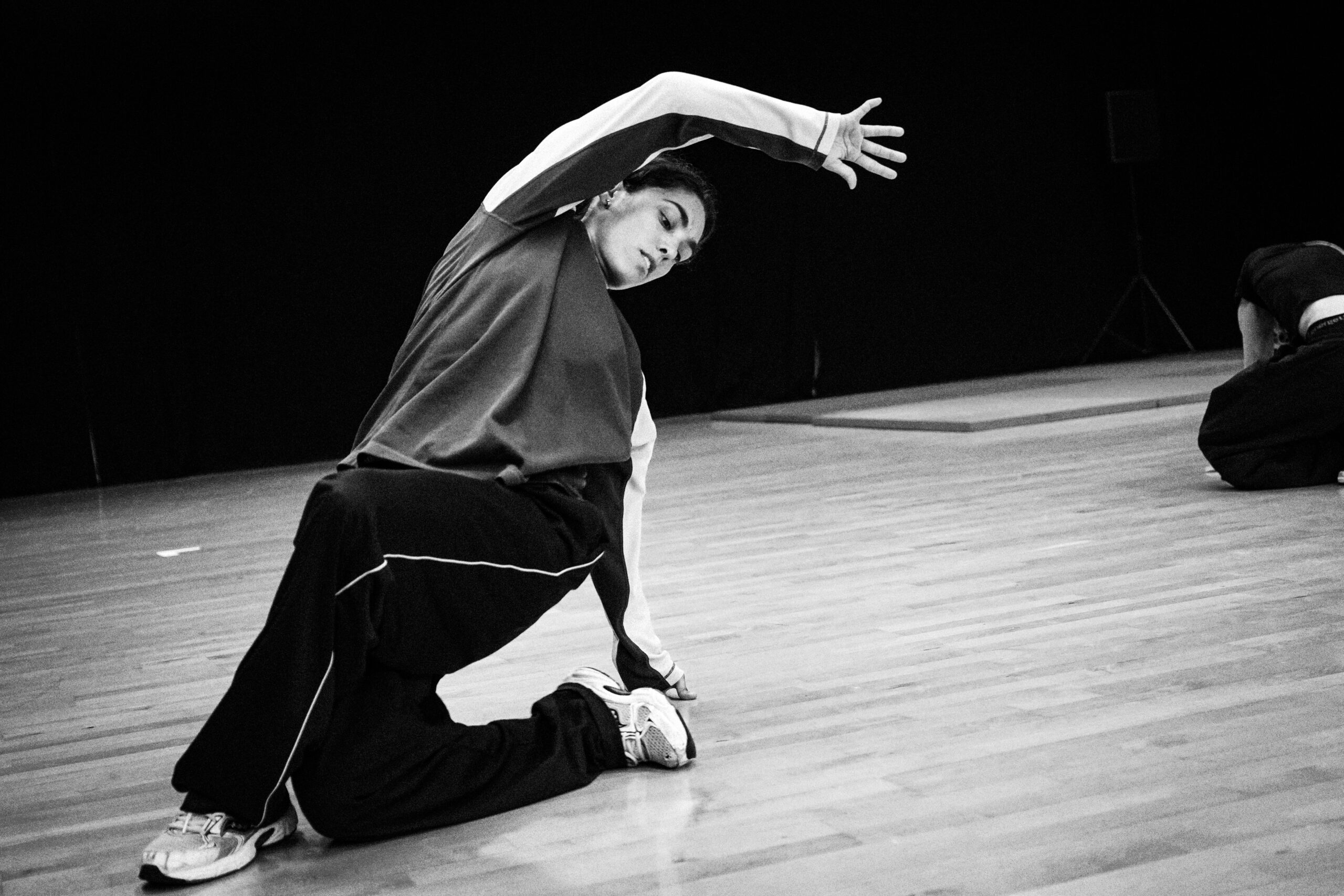
Breaking is approached as an instinctive practice, structured by freestyle and letting go. Movement is not fixed in advance: it emerges spontaneously from a body nourished by the energy and music moving through it.
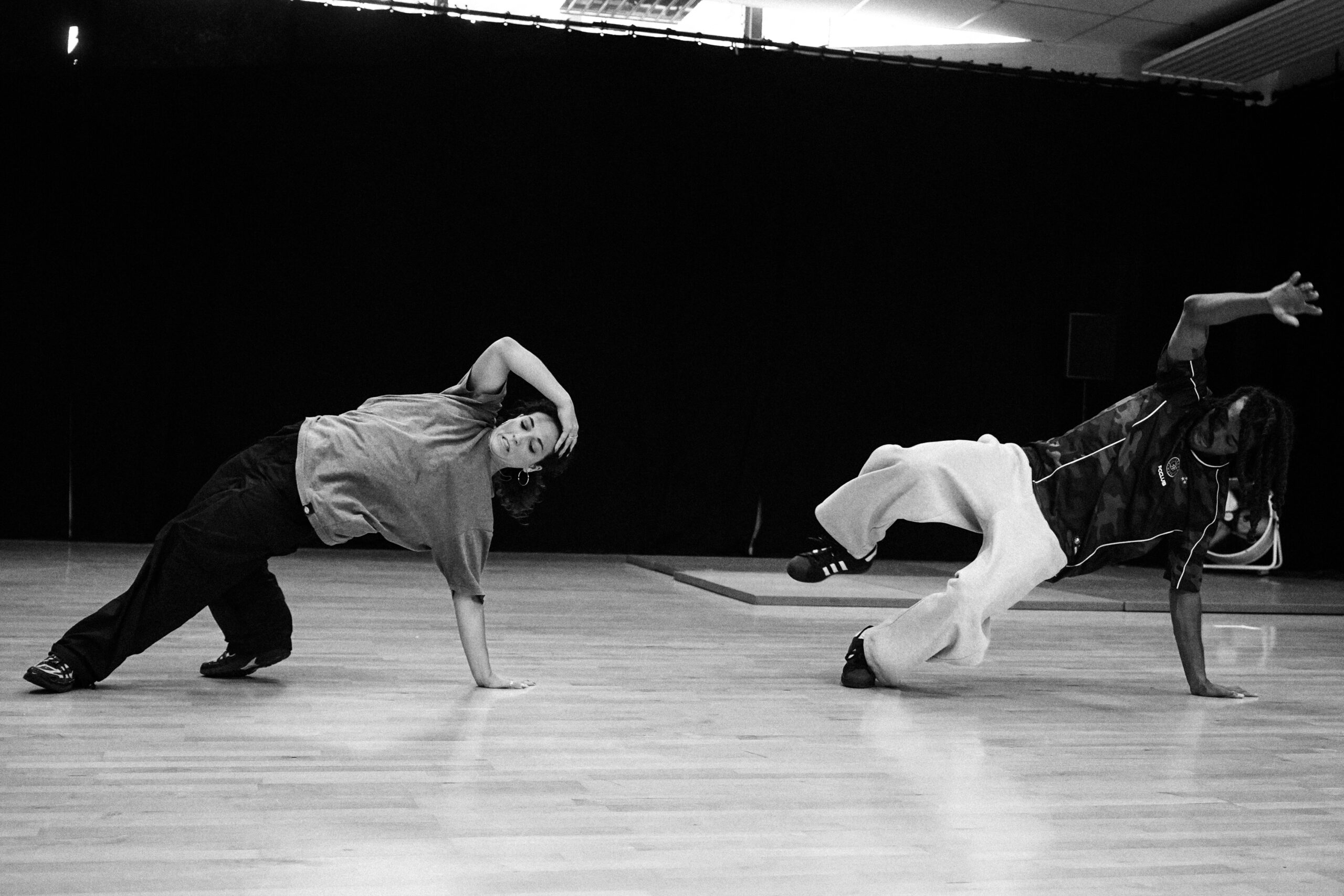
My creative process is rooted in the way breaking moves through the body of each b-boy and b-girl. It seeks to bring together bodies in tension, not through conflict, but by bringing different dance techniques and forms of research into the light. This tension is the driving force of my work.
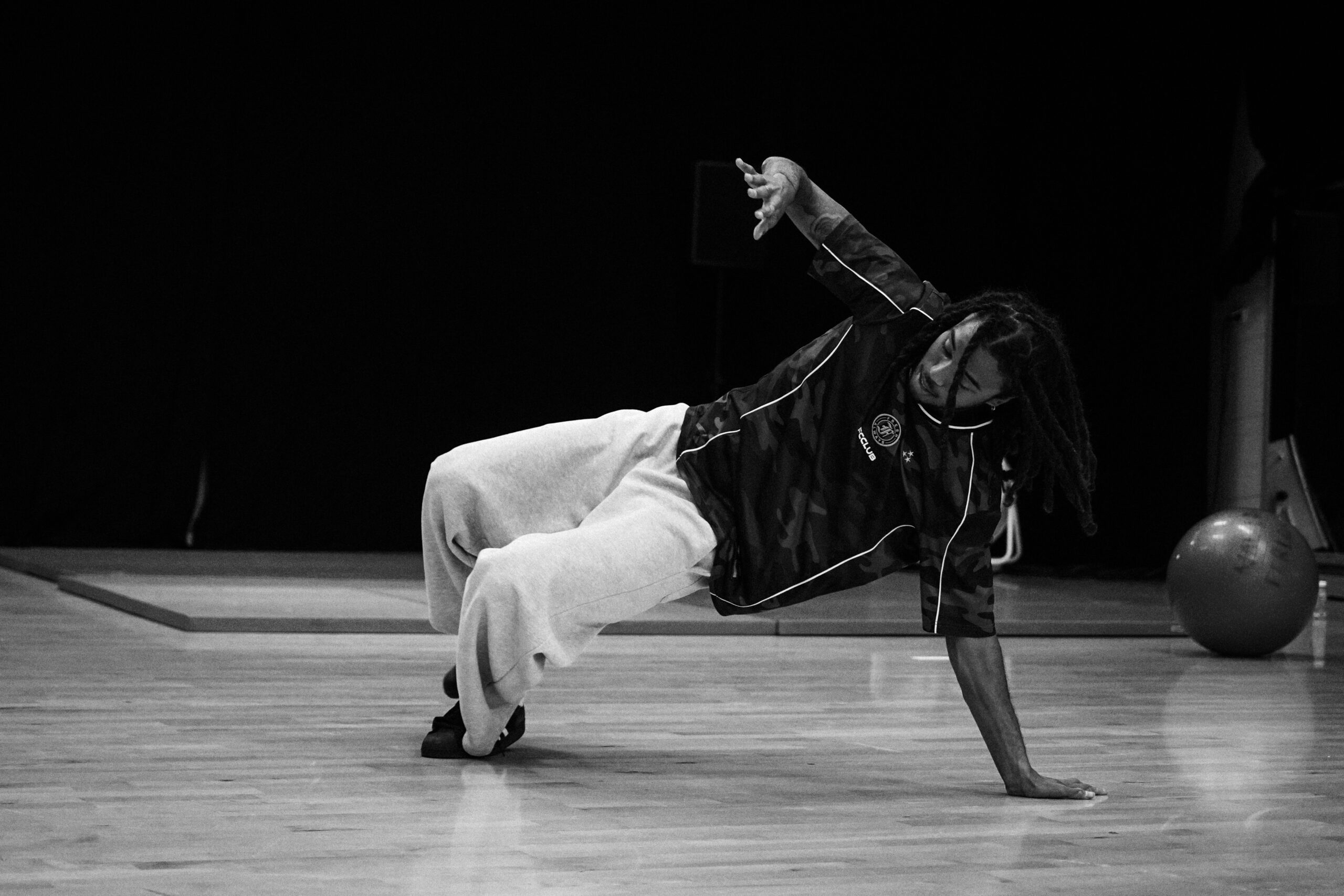
On one side are dancers rooted in a so-called purist approach: exploring the fundamentals, precision in contact with the floor, continuity of direction, quality of descents and a deep grounding in musicality. Their dance is based on a subtle circulation of energy, guided by groove and an organic relationship to rhythm. On the other side are performers engaged in a more performance-oriented search: developing powermoves, tricks and freezes. They question the physical limits of the body, work on the balance between power and flexibility, and seek to reveal a singular, identifiable gesture that carries an identity.
These two schools coexist within the same culture, but rarely meet. They do not move through the same spaces, take part in the same jams or the same battles and when they do meet, particularly in battle, their different relationships to dance, music and performance become especially visible. They develop different ways of thinking about and practising dance.
Read more
In the piece, these two components of breaking are explored with precision. In the first approach, rocking is the point of entry: it sets the tone, engages the body and defines the intention. Without solid rocking, movement loses clarity and tends to become mechanical. Conversely, mastered rocking gives meaning to each transition and makes every descent to the floor clear, readable and inhabited.
This rocking leads us into the geometry of footwork. The shift from verticality to the floor takes place through precise descents, organising support between hands and feet. Weight circulates continuously, without rupture, and the dancers structure this dynamic through clear directions, in close connection with musicality.
The second approach, meanwhile, places the notion of the moment at its core. The performers develop a precise awareness of the instant in which movement appears: the placement of a gesture, the creation of suspensions, the holding of points of balance under tension. This moment, often driven by adrenaline, produces a sensation of suspension that is immediately perceptible to the audience.
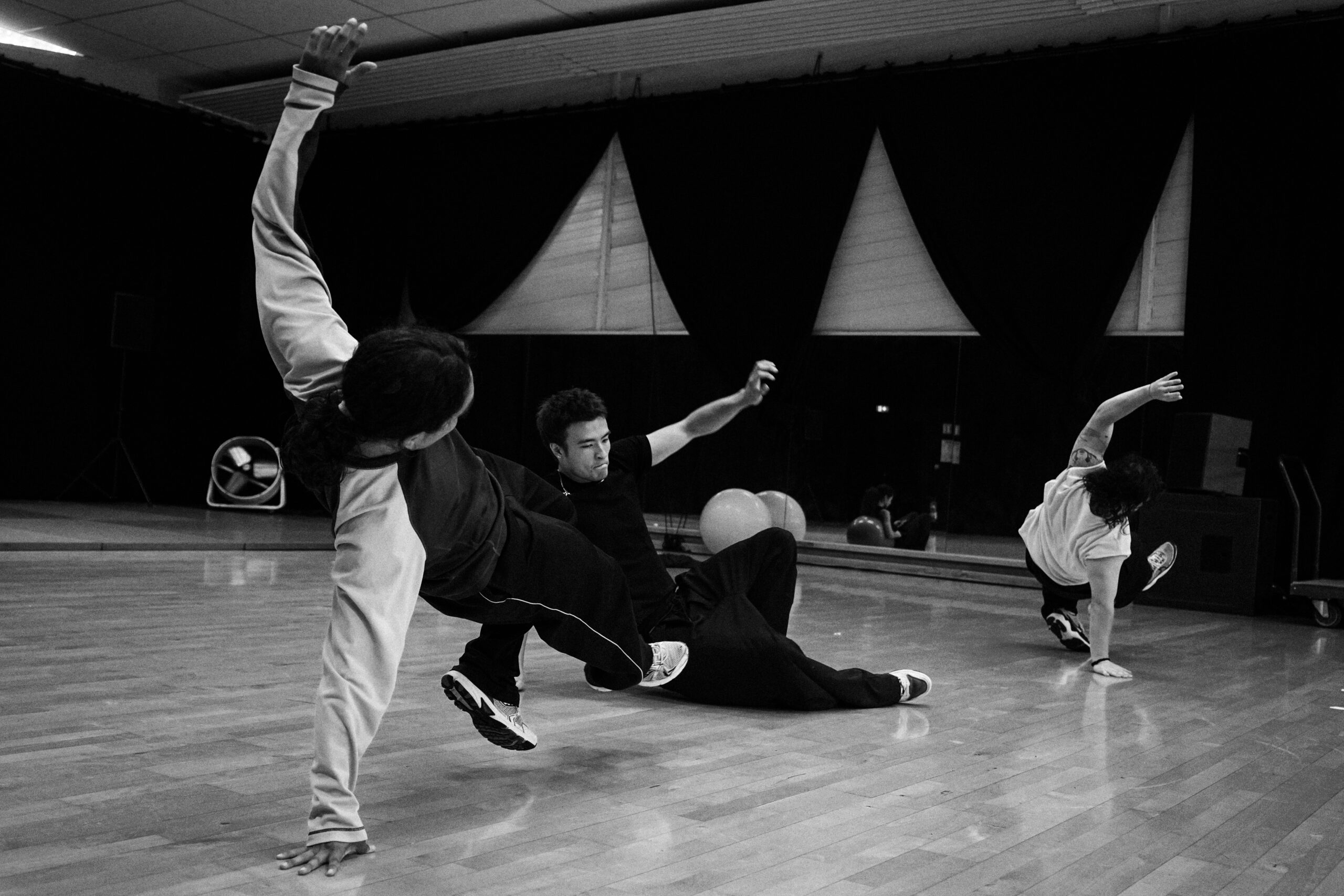
Finally, crew work, which is essential to breaking, structures the piece by bringing these two processes together. It unites these differences in bodies and choreographic languages within a collective dynamic. This work allows the committed message of breaking to be transcribed as a dance of resistance and identity expression. It draws on the practice of stances, b-boy and b-girl positions in which strongly engaged bodies project an energy that can be felt and transmitted. The aim is not to unify, but to assert a shared choreographic language born from these singularities. These highly powerful sequences set out a clear intention: to impose breaking as a practice with its own inner logic, without conforming to a dramaturgy or codes that do not belong to it.
The Get Down, which refers to “the moment when the music becomes especially infectious and people start dancing”, is the perfect synergy of these two movements, allowing breaking to exist in all its virtuosity.
Moncef Zebiri
MUSICAL INTENTIONS
Musically, James Brown became an obvious reference for me. He is a tutelary figure for dancers. He, too, never danced to please. He danced to survive, to claim his place. His drum solos were not musical ornaments, they were pulses, amplified heartbeats that asserted his dignity and called bodies into movement. A movement that was not only physical, but also philosophical. When Clyde Stubblefield hit his snare, he was not simply playing: he was defying authority.
That is exactly where breaking was born. In those in-between spaces, in that place where bodies are called to be alive. The first b-boys did not dance to James Brown’s music. They danced to hammer their presence into the world. I choose James Brown as an act of fidelity. Not out of nostalgia, but as an acknowledgement of debt. A way of saying: this is where we come from, this is what made us dance before anyone told us how to dance. James Brown cried “Say it loud, I’m Black and I’m proud” while b-boys inscribed that same pride into the concrete of the streets. We share the same revolts. So bringing James Brown back live into this piece means summoning the original energy again. It is a reminder that breaking was not born in the hushed silence of dance studios, but in the roar of sound systems, in funk, in the sweat of block parties.
Read more
Arthur Caget’s work is rooted in an exploration of the funk and soul rhythms that deeply influenced the history of hip-hop and urban culture. Drawing on rhythmic patterns and grooves directly inspired by James Brown’s iconic works, he reinterprets these forms while highlighting the structure and energy of the drum lines that shaped these classics.
In the funk and soul music of the 1960s and 1970s, instrumental passages in which the drums were isolated, known as breakbeats, were used by the first DJs at block parties. These rhythmic segments, such as the famous Funky Drummer break played by drummer Clyde Stubblefield on a James Brown track, were looped by DJs like DJ Kool Herc to create the rhythmic foundation of early hip-hop.
Moncef Zebiri
DISTRIBUTION
Choreography: Moncef Zebiri
Dancers: Andrea Mondoloni, Damani Dembélé, Anthony Mezence, Ines Saidani, Audrey Lambert, Luka Pernaud, Alexander Ihara Muus, Dylan Eusèbe, Yoann Thomas, Zinedine Amari
Music creation: Arthur Caget & his live band
Lighting design: Baptiste Chenin
Stage manager: Baptiste Chenin
Costumes: Gabrielle Marty
Set design: Aude Vanhoutte
CREDITS / Production
Production: Le BLOCK · Centre Chorégraphique National de Rillieux-la-Pape (CCNR)
Co-productions: Théâtre de Villefranche-sur-Saône, more to be announced
Residencies: Théâtre de Villefranche-sur-Saône, L’Échappée – médiathèque de Rillieux-la-Pape, more to be announced
Photos © Tony Noël
Length: 50 min
CALENDAR 2027
Gallery